
RCS Category Technical Regulations
1. Weight and Tyres
All vehicles must comply with the following minimum weights:
Category S – Minimum Weight
| Engine capacity | Minimum weight |
|---|---|
| Up to 1,000 cc | 670 kg |
| Over 1,000 cc and up to 1,400 cc | 760 kg |
| Over 1,400 cc and up to 1,600 cc | 850 kg |
| Over 1,600 cc and up to 2,000 cc | 930 kg |
| Over 2,000 cc and up to 2,500 cc | 1,030 kg |
| Over 2,500 cc and up to 3,000 cc | 1,110 kg |
| Over 3,000 cc and up to 3,500 cc | 1,200 kg |
| Over 3,500 cc and up to 4,000 cc | 1,280 kg |
| Over 4,000 cc and up to 4,500 cc | 1,370 kg |
| Over 4,500 cc and up to 5,000 cc | 1,470 kg |
| Over 5,000 cc and up to 5,500 cc | 1,560 kg |
| Over 5,500 cc | 1,650 kg |
For turbocharged or supercharged engines, the actual engine capacity must be multiplied by a coefficient of 1.6 to determine the applicable capacity class.
Ballast: If a vehicle is lighter than the minimum weight required for its class, ballast may be added at one or more points within the vehicle. The ballast must be securely fixed so that it cannot move or be removed during the event.
Tyres
- Maximum tyre width: 265 mm.
- Tyre type: Free.
2. Bodywork
- The vehicle must retain its original production body shape. The only exception is the wheel arches, which may be widened.
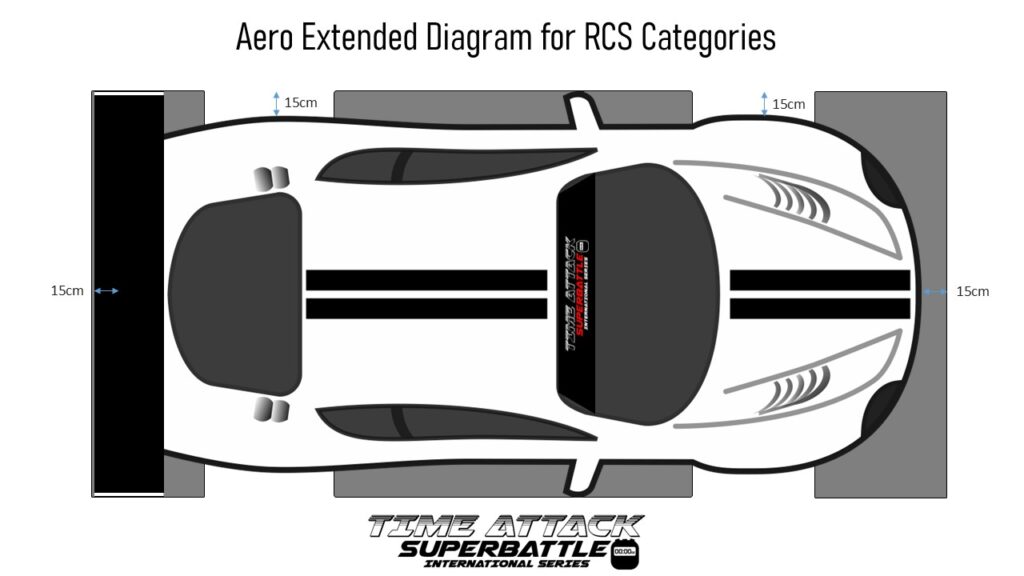
- Front and rear aerodynamic devices must not extend beyond the overall width of the vehicle’s wheel arches.
- The wheels must not protrude beyond the vehicle’s wheel arches.
- Body kits are free.
Note: Splitters and canards must not extend more than 15 cm beyond the outermost point of the body kit around the vehicle.
3. Chassis
No chassis or body-shell modifications are permitted, except for widening the wheel arches where required to increase the overall width of the vehicle.
The installation of the safety roll cage must comply with the provisions of the latest applicable edition of the FIA Appendix J – Article 253 – Safety Equipment for Groups N, A and R-GT.
4. Doors
- All doors must retain the same shape as the original production doors.
- All doors may be replaced with doors made from a different material, except for the driver’s door, which must remain the original production door.
- Removal of the window mechanisms is permitted.
- The original windows may be replaced with polycarbonate windows of at least 5 mm thickness.
- If the original glass windows are retained, a protective anti-shatter film must be fitted to the driver’s side window.
- Both front doors must be capable of being opened from both inside and outside the vehicle.
5. Bonnet and Boot Lid
- The construction material is free. However, the original shape must be retained, and each panel must fit correctly in its original location.
- The bonnet and boot lid must each be secured by two safety fasteners.
- The original opening and locking mechanisms must be removed. The bonnet and boot lid must be capable of being opened only from outside the vehicle.
- Openings, vents and aerodynamic elements on the bonnet are permitted, provided that they do not interfere with the operation of any engine system.
6. Engine
- The engine is free, provided that it originates from the same manufacturer as the vehicle’s body shell.
- Engine modifications are permitted, provided that the engine capacity remains unchanged.
- The engine must remain in its original location and may not be relocated to another part of the vehicle.
- For vehicles originally fitted with forced induction—turbocharged or supercharged—the original production turbocharger or supercharger may be used without an air restrictor in Time Attack events.
- The use of nitrous oxide (NOS/N₂O) is prohibited.
7. Gearbox
Free.
8. Propeller Shaft, Driveshafts and Differentials
Free.
9. Interior
- All vehicles must be fitted with a dashboard.
- The dashboard may be replaced or modified.
- The vehicle floor may be modified where necessary to accommodate a different gearbox or transmission system.
- The vehicle’s firewall, which separates the engine compartment from the passenger compartment, must not be relocated or modified.
- All accessories are permitted, provided that they do not obstruct the driver’s visibility or interfere with the driver while operating the vehicle.
- All pipes, hoses and cables passing through the passenger compartment must be properly protected and covered.
- No pipe, hose or cable connection may remain exposed within the passenger compartment.
10. Engine Cooling System
The engine cooling system is free. However, the water radiator must remain in its original production location and may not be relocated to another part of the vehicle.
11. Braking System and Pedal Box
Free.
12. Suspension System
Free.
13. Lights
- The original front and rear lights may be removed. However, any openings left by their removal must be properly covered or sealed.
- All vehicles must be fitted with operational front and rear lights.
- Operational brake lights are mandatory.
14. Towing Eyes
- At least one towing eye must be fitted at the front and one at the rear of the vehicle.
- Each towing point must be clearly indicated by an arrow.
15. Seats
- Seats must be FIA-approved.
- The installation and mounting of the seats must comply with the provisions of the latest applicable edition of the FIA Appendix J – Article 253 – Safety Equipment for Groups N, A and R-GT, specifically the provisions concerning seat installation and anchorage.
Expired homologation: A seat whose FIA homologation has expired may be used for an additional period of up to two years, provided that it remains in good condition and is approved by the event’s Technical Committee or Scrutineer.
16. Windscreen
- The windscreen must be made of laminated glass and must have a minimum thickness of 5 mm, equivalent to the original production windscreen.
- At least one operational windscreen wiper must be fitted.
17. Handbrake
Free.
18. Engine, Gearbox and Fuel Tank Protection
Free.
19. Fire Extinguisher
Each vehicle must carry at least one 4 kg fire extinguisher or two 2 kg fire extinguishers.
20. Fuel Tank
- The original production fuel tank may be retained.
- If the original fuel tank is replaced with a competition fuel tank, the replacement must comply with the relevant FIA requirements and specifications.
- An FIA-approved competition fuel tank whose homologation has expired may still be used in Time Attack events, subject to inspection and approval by the Scrutineer.
- If a non-FIA-approved fuel tank is to be used, it must receive prior approval from the Time Attack Technical Committee before the competitor submits their entry.
21. Master Switch
- A master electrical cut-off switch must be installed in an easily accessible position close to the windscreen.
- The location of the master switch must be clearly identified by the appropriate electrical cut-off symbol.
22. Safety Harnesses
- Safety harnesses must be FIA-approved and have a minimum of six anchorage points.
Expired homologation: FIA safety harnesses whose homologation has expired may be used for an additional period of up to two years, provided that they remain in good condition and are approved by the Scrutineer.
General reference: Wherever these regulations refer to FIA Appendix J – Article 253, the latest applicable edition in force on the date of the event shall apply.